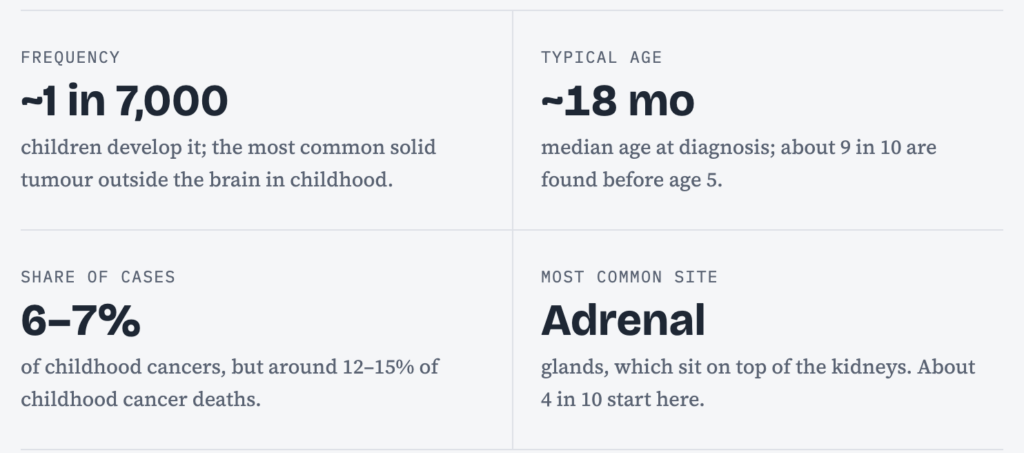
Our research is focused on neuroblastoma, a cancer of immature nerve cells that almost only affects babies and young children. It is one of the most unpredictable tumours in medicine: some vanish on their own, others are among the hardest childhood cancers to cure.
The genes that change the odds
MYCN amplification
Extra copies of the MYCN oncogene appear in about 20–25% of tumours. It drives aggressive growth, and any child with it is usually treated as high-risk regardless of stage.
ALK & PHOX2B
ALK mutations occur in roughly 10% of tumours and are the main cause of the rare inherited form (1–2% of cases). ALK can be targeted with drugs such as lorlatinib.
Chromosome changes
Losses of 1p or 11q and gains of 17q signal more aggressive disease. Whole-chromosome gains (hyperdiploidy) in infants tend to mean a better outlook.