IACR 2026: Science, Communication, and Impact 

 I recently had the opportunity to attend and present my research at the Irish Association for Cancer Research Conference 2026 in Galway. This year was particularly special for me, as I was selected as one of six early-career researchers to take part in the Prof. Patrick G. Johnston Award for Excellence in Cancer Research Outreach. 

This award recognises researchers who can communicate their work clearly to a public audience. Those selected are chosen based on their lay abstracts and take part in a patient communication workshop ahead of the conference. As part of this, I had the opportunity to work closely with patient advocates and cancer survivors, which was an incredibly valuable experience. It challenged me to think beyond science and focus on how to make my research meaningful, accessible, and relevant to the people it ultimately aims to help. 

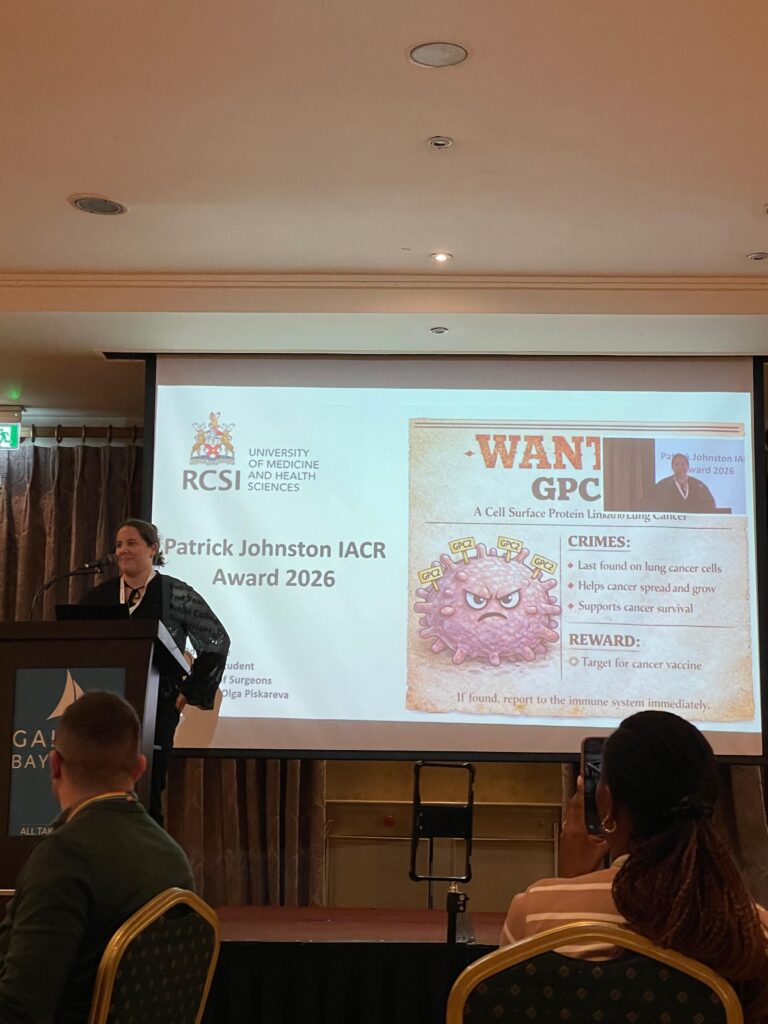
My presentation at IACR 2026

During the conference, I presented my research as part of this award session, delivering a lay presentation to an audience made up of scientists, patients, and members of the public. 

My research focuses on developing 3D lung models to better understand cancer behaviour and explore new ways to target lung cancer using mRNA-based approaches. Being able to present this work in a way that resonated with a non-scientific audience was both challenging and rewarding. 

Overall, the conference was an inspiring experience. It reinforced the importance of communication in cancer research and reminded me that behind every project are patients and families who are directly impacted by the work we do. 

Until next time,  

Written by Eve O’Donoghue

National PPI Festival 2024: Let’s Talk About Childhood Cancer Research

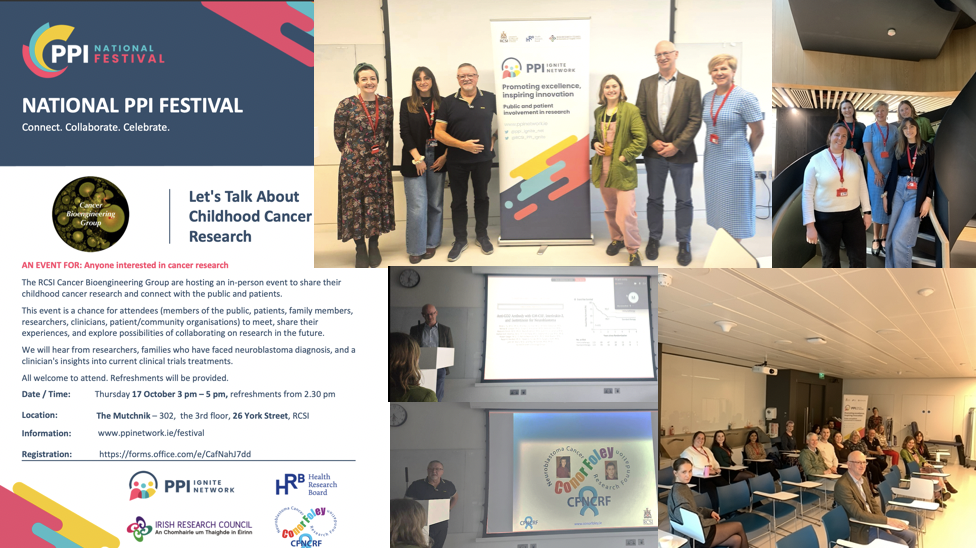
The RCSI Cancer Bioengineering Group hosted an in-person event during the National PPI Festival 2024 to share their childhood cancer research and connect with the public and patients.

We welcomed members of the public, family members of children with cancer, researchers, clinicians, and patient/community organisations on October 17th. Our past lab members and students paid a visit, too! Our group shared ongoing research on neuroblastoma biology and finding new treatments. Prof Cormac Owens from CHI brought us through the journey of clinical trials in neuroblastoma patients. We heard the heartbreaking story of the brave young man who lost his life to neuroblastoma and his parents who never gave up. This truly inspirational family founded a charity – the Conor Foley Neuroblastoma Cancer Research Foundation, to support curiosity-driven and translationally-focused research. The Foleys know very well how important it is to return happy days to kids and their families.

We thank RCSI PPI Ignite for supporting us!

Stay in touch!

Bad days come and go …

The researcher’s path includes days when you feel so low because your grant or paper was rejected or even both within a very short time frame. It happened to me a couple of weeks ago. At this point, I felt helpless sarcastic and non-motivative reading reviewer’s comments. One reviewer mixed up neuroblastoma with a brain tumour,  so their comments were not relevant. Another just found no time to read through, the sentence was very short – ‘not a priority or interest‘. One more went to their area of expertise asking to fulfil it rather than comment on the actual focus of the study. Such comments are so common that any submission of results or a proposal could be considered as a draw. It has been neither my first time not the last. More to come.

At that time a friend of mine shared the reflection by a breast cancer survivor and now volunteer patient advocate at Europa Donna IrelandThe Irish Breast Cancer Campaign.

Lastly, I would also like to say that research makes a difference to my life in another way, a less concrete but equally important way: it gives me hope. To know that excellent, focused research is happening in this country, to think that even I might be able to contribute to the success of this work, even to imagine that my daughter might grow up without fear of breast cancer – this gives me enormous hope.” (The full story can be read here)


These words make a big difference for me as a researcher. They motivate to go further and make the difference for little patients.