#ChildhoodCancerAwarenessMonth is over. However, childhood cancer is not going away. The battle is not over. Families will be still affected by the lack of treatment options available to their child. More research is needed. Please do support enthusiastic people who do want to make the change. Every single contribution counts.
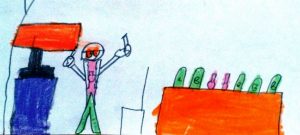
Scientist as imagined by a 7-year-old boy
The more important reason is that the research itself provides an important long-run perspective on the issues that we face on a day-to-day basis. (Ben Bernanke)
I would like to thank everyone who followed my blog during this month and hope would continue!
We hear great news from the US labs that a new treatment is on the way for children with cancer. Most of their research is funded by charities and success stories appear because of the people who want to make dreams come true for kids with cancer and their families. Dreams for longer and healthier life.
Interestingly, the study led by Professor Bernie Hannigan, the University of Ulster, which was published by Medical Research Charities Group, identified main gaps that keep Ireland at the bay:
Childhood cancer research areas are not prioritised, including neuroblastoma.
No Government funding support for childhood cancer research. The research has to compete on general terms with well-funded research groups/centres/clusters focused on the adult cancers (breast, prostate, etc)
No systematic involvement in research of Patients or other lay people.
No medical research charities to fill the gap in childhood cancer research funding.
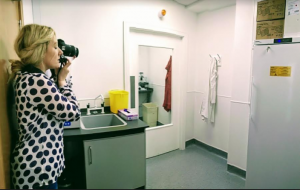
In preparation for ‘Discovery’ Launch Night-An Exploration of Cancer Research Through Art, the event that took place on Tuesday at The Tara Building. Tara Street, D2.
Things that are absolutely ordinary for researchers become inspirational! I was glad to be able to provide such environment.
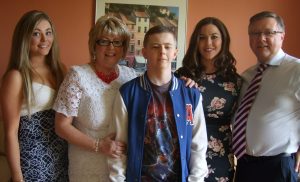
Continuing the fundraising theme, I would like to introduce The Conor Foley Neuroblastoma Cancer Research Foundation. It is founded by the family aiming to raise awareness and funding for neuroblastoma – one of the most aggressive childhood cancer. This charity is being driven by parents who lost their son to neuroblastoma. They want to fill this gap as well as bring attention to the lack of funding for childhood cancer research.
Their son Conor was diagnosed with neuroblastoma at the age of four. He was a teenager when he relapsed. He had been 10 years cancer-free. After all possible treatments, neuroblastoma took over.
His mom Margaret says:
“We always dealt with Conor’s illness privately. There were no Facebook pages tracking Conor’s progress. The day we launched the website for Conor’s charity was very emotional for me. I feel like he is out there now in the big world now with his charity. He will never get to do the things that most 18-year-olds do. He won’t go inter-railing in the summer, he’ll never go bungee jumping off some bridge, but I feel that he’s part of the world, doing something good for other children and their families. We valued our time with Conor so much, we want to help researchers who will give families, even more time, more options, perhaps even a cure for their children when they get the same awful news that we did. I think he would approve of that.”
Dedicating posts to neuroblastoma and childhood cancer awareness month, it is impossible to stay distant about the need of fundraising to fund research. The #ChildhoodCancerAwareness Campaign aims not only attract our attention to the fact that kids get cancer too, but mostly to show how little is done to understand the causes of the disease and offer effective treatments.
To address the last problems more research is needed both curiosity-driven and translationally focused. To answer the question why research needs more funding, in general, you can find here.
Effective treatments cost money: only 4% of research funding goes to research in ALL childhood health conditions. In the other words, every 4cents of each 1 euro are to be used in research.
The causes of childhood cancer including neuroblastoma are not known. It would be right to expect more blind alleys and failed ideas in the understanding these cancers.
The research can take decades, so it is a long-term investment. In contrary, people, who can give money (the politicians and governments), have 4-5 years of political power. 4-5 yearsvsdecades = the discovery research becomes critically underfunded.
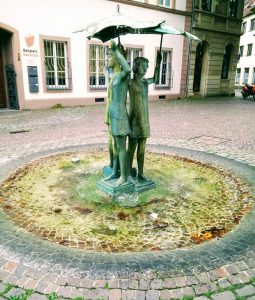
Walking in Mainz last week I saw a lovely fountain capturing 3 girls under umbrellas (Drei-Mädchen-Brunnen) at the ball square. This fountain was built between two Catholic girl’s schools symbolising the separate education and happy childhood. It has charmed me and reminded rainy days in Ireland and how this fountain may fit any park or square in Dublin.
My second look at the picture gave me another perspective. This sculpture could illustrate not only happy childhood but also the protection we can give to children with cancer being their umbrellas. As September is childhood cancer awareness month, I am picking this picture to support this call. Raising awareness about childhood cancer we help to make their dreams come true. Dreams for better treatment, better quality of life full of love ahead through better funding of childhood cancer research and access to innovative treatments.
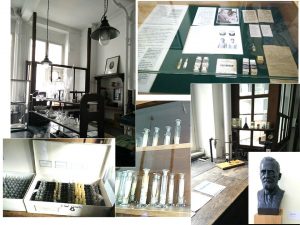
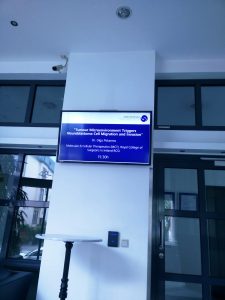
I was giving a talk at Georg-Speyer-Haus Institute for Tumour Biology and Experimental Therapy yesterday. The aim of my visit was to establish collaboration with Prof Daniela Krause, who is the expert in bone marrow microenvironment and targeted therapies. She took me to the Institute museum that keeps the history of this place and phenomenal researchers used to work there.
This research institute was established in 1904 to support work of Paul Ehrlich, its first director and funded by the private foundation “Chemotherapeutisches Forschungsinstitut Georg-Speyer-Haus”. Paul Erlich is the Father of the chemotherapyconcept originally developed to treat diseases of bacterial origin. He reasoned that there should be a chemical compound that can specifically target bacteria and stop its growth. He developed Salvarsan, the most effective drug for treatment of syphilis until penicillin came onto the market.
Paul Erlich is also known for his contribution to cancer research. He and his colleagues actively experimented on how tumour originates and spread. They also tried to understand how immune system can beat cancer applying vaccination concepts.
The main challenge in treating high-risk neuroblastoma is to stop or control tumour spread and development of resistance to multiple chemotherapeutic drugs. Immunotherapy is one of the recent advances in our understanding how our immune system handles body invaders such as virosis, bacteria and now tumour cells. Immunotherapy holds great promise as a treatment option for neuroblastoma as well as for many adult cancers owing to the specificity of immune effector cells targeted to a tumour. Another advantage is a potential reduction in the systemic side effects observed with other forms of treatment.
Immunotherapeutic approaches for neuroblastoma include the use of chimeric antigen receptor (CAR) T cells against both L1-CAM and ganglioside 2 (GD2) cell surface antigens to promote host antitumor response. Anti-GD2 antibodies bind GD2 and cause cell death by activating both complement-dependent cytotoxicity (CDC) and AB-dependent cellular cytotoxicity (ADCC) from natural-killer cells.
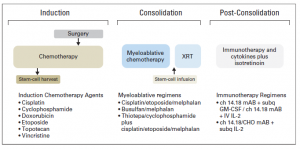
Children with high-risk neuroblastoma is the most challenging group to treat. Current treatment strategy for this group consists of 3 treatment blocks:
induction: chemotherapy and primary tumour resection;
consolidation: high-dose chemotherapy with autologous stem-cell rescue and external-beam radiotherapy [XRT];
post-consolidation: anti–ganglioside 2 immunotherapy with cytokines and cis-retinoic acid.
Adopted from: Pinto NR et al JCO 2015, 33, 3008-3017.
Up to 50% of children that do respond experience disease recurrence with tumour resistant to multiple drugs and more aggressive behaviour that all too frequently results in death.
For the majority of children who do survive cancer, the battle is never over. Over 60% of long‐term childhood cancer survivors have a chronic illness as a consequence of the treatment; over 25% have a severe or life‐ threatening illness.
To be able to guide the treatment of neuroblastoma patients, doctors have developed a number of classification systems. Although sharing common features, they slightly vary by medical center, country and continents making direct comparisons of treatment results difficult. Doctors and scientists are trying to consolidate all systems in one in order to evaluate treatments in the past, currently ongoing and in the future.
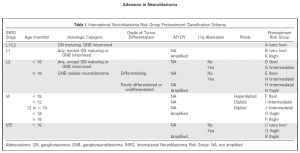
Scientists have suggested a newer risk group classification system, the International Neuroblastoma Risk Group (INRG) classification that would incorporate the best knowledge gained and recent advancements in the disease imaging and neuroblastoma molecular diagnostics. This system is based on imaging criteria using the image-defined risk factors (IDRFs) and the prognostic factors such as:
The child’s age
Tumour histology (the tumour appearance under the microscope)
The presence or absence of MYCN gene amplification
Certain changes in chromosome 11 (known as an 11q aberration)
DNA ploidy (the total number of chromosomes in the tumour cells)
The table is adapted from Pinto NR J Clin Oncol. 2015
Using these factors the INRG classification put children into 16 different pre-treatment groups (lettered A through R). Each of these pretreatment groups is within 1 of 4 overall risk groups:
Very low risk (A, B, C)
Low risk (D, E, F)
Intermediate risk (G, H, I, J)
High risk (K, N, O, P, Q, R)
This system has not yet become common across all medical centers, but it is being researched in new treatment protocols.
Doctors and scientists are planning to improve the INRG classification system by incorporating other molecular diagnostics data such as profiles of the neuroblastoma genome (DNA), transcriptome (RNA), and epigenome* in order to make precise prognostication even better.


 I was giving a talk at