Ever wonder how scientists figure out a specific protein’s role in cancer?

Researchers use various methods, but I employ gene knockdown in my experiments. Basically, I use small RNA molecules that specifically target and degrade the mRNA of my gene of interest. This leads to a decrease in the corresponding protein levels, enabling me to observe the effects on neuroblastoma cell behaviour.

I feel a bit like Sherlock Holmes, you know? I’m selectively putting my suspect protein – the one I’m eyeing – under the spotlight to see how it’s pulling the strings on the cell’s behaviour. It’s like I’m in a cellular mystery, complete with a gene knockout magnifying glass 🔍🧬🕵

So, what I’ve been up to these past months is knocking down my protein and trying to find answers to the following questions:

Can neuroblastoma cells survive? And if not, how do they meet their demise? Do they go on a growth spree and start proliferating? Are they capable of migration? And here’s the twist – when my protein of interest takes a dip, do other proteins decide to change their expression levels?

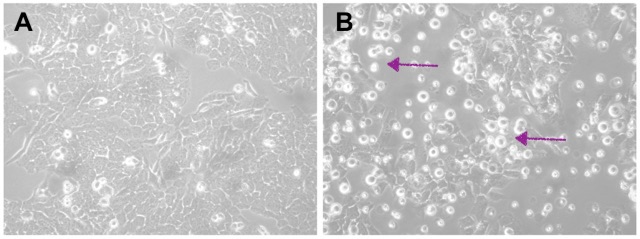
The picture below can probably help you get an idea of what I’ve done so far. Do you see those brighter spots in Pictures A and B? Those are dead cells. Their number indicates the proportion of dead cells after a treatment. Picture A has just a few; the majority are healthy and well-spread cells. This is our negative control, a condition when we show neuroblastoma cells that have been transfected, but no gene knockdown happened. Transfection is the term for introducing small RNA molecules. Now, in Picture B, when we knocked down the protein, it caused the death of the cells, and you can clearly see that from all those many little bright spots.
We have found answers to many of the previous questions, but new questions have arisen, and we can’t wait to answer them!

Written by Federica Cottone

International Childhood Cancer Day – 15 February 2024

We are celebrating #ICCD2024 with a Bake Sale and a Quiz. To earn a piece of cake, you have to answer a question correctly! Have a look at some:

  • Which civilisation first described cancer?
  • Where did the word cancer come from?
  • Do children get cancer?
  • What is the most common type of cancer in children?
  • Can the Human Papillomavirus (HPV) vaccine prevent cancer?
  • Can neuroblastoma begin to develop before birth?
  • What is the name of the nerve cell in which neuroblastoma begins to grow?
  • Can a child have a genetic predisposition to neuroblastoma?
  • What % stands for the incidence of neuroblastoma: 8 or 15?
  • What % stands for the neuroblastoma-related deaths: 8 or 15?
  • Does neuroblastoma first appear in the brain?
  • What does the letter N stand for in the gene MYCN?
  • How often does childhood cancer occur compared to adults?
  • How often does hereditary cancer happen in general?
  • Do you think that children are small adults when we talk about anticancer treatment?

How things work in Science: Classifiers

For our next little series introducing a different thing in science and how it works every week, I decided to focus on classifiers. With artificial intelligence becoming more and more prominent in our daily lives as of late, I thought this would be a good lead into the explicitly science-focused topics to come. So, what is a classifier? How does it work? And why does it matter?

At their core, classifiers are algorithms designed to categorize input data into predefined classes or categories. They learn patterns and relationships from labelled training data to make predictions on new, unseen data.

Once features are extracted, identified and quantified from labelled or annotated input data, mathematical models are employed for pattern recognition and predictions.

These models can range from simple decision trees to complex neural networks, each with its own strengths and weaknesses.

Training these models is an iterative process. That means to produce one good classifier, lots of classifiers were created in the process: Every time the pattern recognition is run, the annotated data is categorised by the classifier and compared to the annotation class. Prediction errors are corrected, and performance is optimised. This whole process is one iteration. How many iterations are required for a well-trained classifier varies widely and is largely dependent on the input data and application. For my tissue classifiers, it took up to 20,000 iterations.

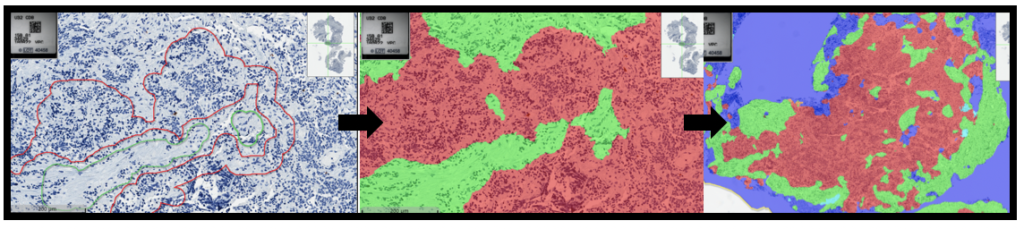
Classifiers use these models to categorise unseen data into categories the user-defined at the start. In the figure, you can see my annotated histological slides from which the classifier extracted patterns to then classify the rest of the slide and entirely unseen slides into tumour (red), stroma (green) and background (blue) classes.

From identifying fraudulent transactions, filtering out junk mail, targeted advertising, and facial recognition to unlock your phone or diagnosing diseases, classifiers play a vital role in automating decision-making processes and driving advancements across a wide range of industries. Keep your eyes peeled, and you can find more classifiers in action all around you.

Written by Ronja Struck