Women in Science: Madame Curie

Women have made significant contributions to the field of science throughout history, but they have often faced gender-based barriers and discrimination. Despite the challenges, several pioneering women made significant contributions to various scientific fields. Marie Curie, for example, conducted ground-breaking research in radioactivity and was the first person (and remains the only woman) to win Nobel Prizes in two different scientific disciplines (physics and chemistry). In 1903, she received the Nobel Prize in Physics along with Pierre Curie and Henri Becquerel for their work on radioactivity. Later, in 1911, she received the Nobel Prize in Chemistry for her contributions to the understanding of radium and polonium. These discoveries had a profound impact on the understanding of atomic and nuclear physics and laid the foundation for numerous scientific and medical advancements. They led the development of X-ray machines for medical diagnosis and the development of cancer treatment through radiation therapy (NobelPrize.org, 2023).

As a woman in the 20th Century, Madame Curie too faced early struggles with financial and gender-related challenges in her pursuit of education. She had to work hard as a governess and in other low-paying jobs to support her sister’s education before she could attend University. Her struggles continued into her research, where she first published her early scientific work under the pseudonym “Pierre Curie” to avoid gender bias and prejudice. This allowed her to have her work taken more seriously. However, despite her struggles to receive an education, in 1906, Marie Curie herself became the first Female Professor at the University of Paris (MarieCurie.org, 2023)

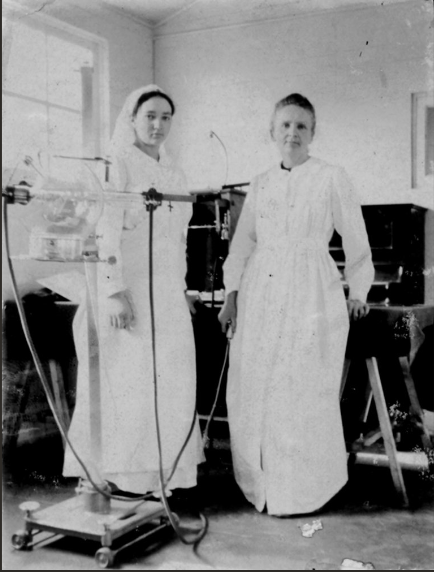
Marie Curie not alone made epic contributions to science, she was also involved in war efforts. During World War I, Marie Curie developed mobile radiography units, or “Little Curies,” to provide X-ray services to wounded soldiers. She and her daughter, Irène, operated these units on the front lines. She also served as the director of the Red Cross Radiology Service and trained nurses and doctors in radiography (Davis, 2016).
Madame Curie passed away on July 4, 1934, in Sallanches, France, but her legacy in the world of science endures. Marie Curie’s personal cookbook and other belongings are still radioactive and are stored in lead-lined boxes at the National Library in Paris. They will remain radioactive for thousands of years. The Musée Curie (Curie Museum) is a museum located in Marie Curie’s former laboratory at the Institut du Radium in Paris. It showcases her personal artefacts, laboratory equipment, and documents related to her research on radioactivity. If you are holidaying in Paris, you can take an hour and explore the laboratory space and learn about the scientific achievements of Marie Curie and her husband, Pierre Curie. For me, Marie Curie’s dedication to research, numerous contributions to the field of radioactivity, and her status as a trailblazing woman in science is inspiring. I hope her legacy will continue to inspire generations of scientists and serve as a testament to the power of scientific curiosity and perseverance.

Fun fact: Radium became a popular element in various consumer products during the early 20th century. It was added to items like toothpaste, face creams, and even drinks, all of which claimed to provide health benefits. Marie Curie herself endorsed some of these products before the health risks of radiation exposure were well understood (Santos, 2021).

Written by Ciara Gallagher

Reading:

DAVIS, A. 2016. How Marie Curie Helped Save a Million Soldiers During World War I The radiology pioneer developed and operated mobile X-ray units to treat the injured. Available: https://spectrum.ieee.org/how-marie-curie-helped-save-a-million-soldiers-during-world-war-i [Accessed 2023].

MARIECURIE.ORG. 2023. Marie Curie the scientist [Online]. Available: https://www.mariecurie.org.uk/who/our-history/marie-curie-the-scientist#:~:text=Born%20Maria%20Sk%C5%82odowska,She%20never%20lost%20this%20passion. [Accessed].

NOBELPRIZE.ORG. 2023. Marie Curie [Online].  [Accessed 24/10/23 2023].

SANTOS, L. J. 2021. “A Revolutionary Beauty Secret!” On the Rise and Fall of Radium in the Beauty Industry. LitHub.

Women in Science: “I felt like a God”- Dr. Katalin Karikó

As many will know, the Nobel Prize for Physiology or Medicine 2023 was awarded jointly to Dr. Katalin Karikó and Dr. Drew Weissman in recognition of their contribution to the mRNA technology that laid the groundwork for the Covid-19 mRNA vaccine success. They found that replacing uridine with pseudouridine in mRNA molecules prevented over-activation of an immune response that would normally degrade and remove the mRNA. Combined with successful delivery to cells, this allowed for mRNA to be used as coding machinery to make new proteins in cells that don’t normally produce that protein. One small adjustment changed the landscape of mRNA technology and therapeutics.

Since the Nobel Prize announcement, it has come to light the many obstacles and rejections that Dr. Karikó adapted to over the course of her career and despite it all, was still awarded the most prestigious title in scientific research. Taking inspiration from this, we will run a new blog series to highlight female scientists, their work and what it is that we admire most about them. (Did you know? Only 13 of the 227 Nobel Prize Laureates for Physiology or Medicine were women!)

In her many interviews and discussions, it is obvious that Dr. Karikó has an exceptional positive mental attitude and, most importantly, lives and breathes for science. The title of this blog post, “I felt like a God”, is a quote from Dr. Karikó. Most people will think that it is a reaction to hearing she won the Nobel Prize. But no, it was Dr. Karikó’s reaction in the 1980s to seeing her mRNA inserted into cells and producing a new protein. Dr. Karikó was still working at the bench up until very recently, and this love for lab work and science is one quality that makes her stand out from the crowd. She shy’s away from the “fame” and focuses on “what’s next”. It is these qualities, I assume that meant she could push past the rejections that we know so well in academia and scientific research. Before her and Dr. Weissman’s work was noticed and valued by Pfizer and Bio-N-Tech, Dr. Karikó was let go from the University of Pennsylvania due to a lack of grant funding and struggled to attract interest from both industry and academia. In fact, major journals rejected Dr. Karikó and Dr. Weissman’s work on mRNA modifications, and it was finally published in a lesser-known journal, Immunity.

Rejections are something that every scientist becomes accustomed to, be they grant rejections, job rejections or even “idea” rejections. Dr. Karikó’s ability to firmly believe in her science and never let up is what I admire most about her. She was told so many times to “not bother” with RNA that it would never be used as a therapeutic. And now, her belief and self-confessed obsession with this molecule has contributed to the development of arguably the most ground-breaking therapeutic of the 21st century, the mRNA vaccine. Obviously, as an immunologist, I am biased. But it cannot be ignored how many lives Dr. Karikó’s ambition and determination have benefited.

Dr. Katalin Karikó working at her new desk as a newly-appointed Professor at her alma mater, the University of Szeged, Hungary. Picture courtesy of Dr Kariko’s Twitter account @kkariko.

As women in science, we face unique challenges. Dr. Karikó’s career is not what you would expect from a Nobel prize-winning scientist. It is not littered with tenured positions at Ivy League universities. She struggled for most of her career to get people to listen to her about the promise of mRNA. Moving from her home of Hungary to the United States with her husband and young daughter, Susan, who is now a two-time Olympic gold medallist. When asked how she juggled it all, Dr. Karikó explains how leading by example is the key. It is no wonder her daughter is as successful as she is when Dr. Karikó’s determination, perseverance and self-confidence were what she grew up watching. I truly admire Dr. Karikó’s ability to stand firm in the face of adversity. For me, she stands as a true role model for women scientists and embodies the success that resilience can bring. 

Written by Ellen King

Knit-A-Thon 2023 Results

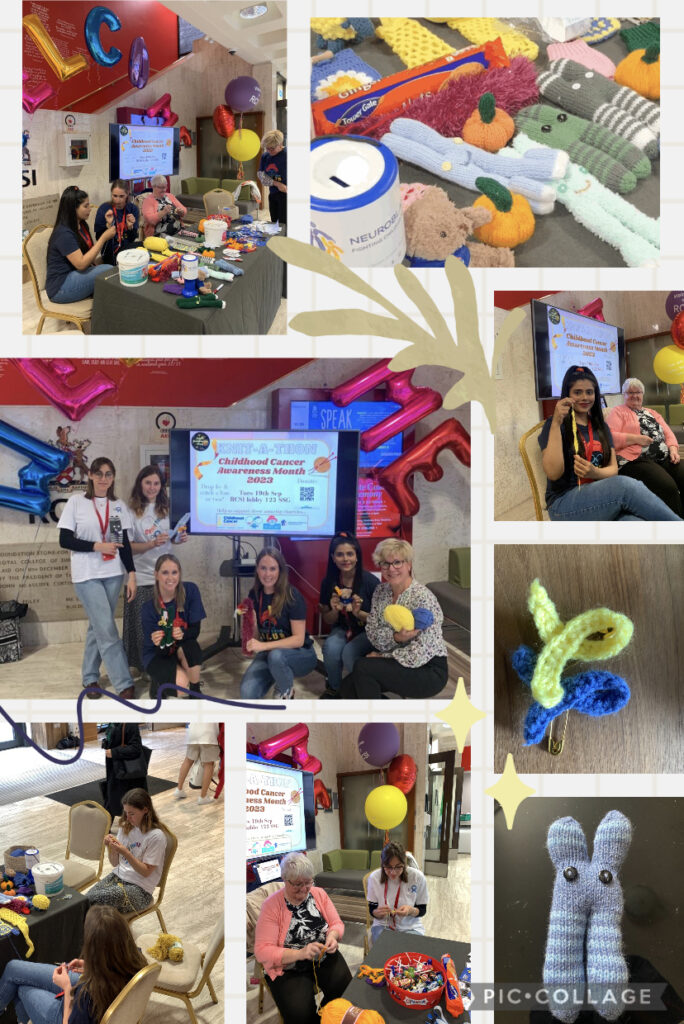
A wonderful day of knitting – Knit-A-Thon-2023 raised 913 euros. A massive thank you to everyone who stopped by and donated on the day and beyond. Every cent counts! The money was split evenly between our four chosen charities: The Conor Foley Neuroblastoma Research Foundation (CFNRF)Neuroblastoma UK (NBUK)Oscars Kids and Childhood Cancer Ireland (CCI). These charities were established and are run by parents, some of whom lost their children to cancer. They continue their children’s legacy, doing an amazing job of advocating for children with cancer and better funding for research and aftercare.

Knit-A-Thon 2023

And a special thank you to Ciara’s mam Aggie for the amazing handmade raffle prizes (chromosomes, antibodies, cup holders and many more) and a Master class on the day! We thank Jenny Duffy (RCSI Events and Communications Coordinator) for her time crocheting with us and for us!  Thanks to Anggie’s and Jenny’s skills, there were lots of mascots to win – and many of them collected already. We much appreciate the support from the RCSI Estates and Porters who looked after us on the day.

Go Raibh Maith Agat!!!

MANY THANKS FOR YOUR BIG HEARTS!!!