How is it feeling?

The fact of being shortlisted is very encouraging. It means that my research proposal and the career achievements fit the merit of this award.  No doubt it was fantastic experience overall, not often the shortlisted candidates have an opportunity to speak for themselves.

How is it feeling after the interview?… Well, I do not have a firm answer… It is a big difference when you explain yourself in written and spoken forms… No chance to edit your real-time talk… How many times have that 30 minutes played back and re-run in my head? I lost the count… Did I bring the point across? Did I do things in right time and at a right pace? Should I have structured the answer differently? Each re-run brings new ways to answer the same questions, indeed, in a better and more concise way…   Having the mind that is constantly analysing the situation is not helpful.

Think, the competition was very tough, and only 1 in 10 made to the 2 days interview for the Fulbright Award (maybe the ratio even higher). Twelve candidates were interviewed yesterday and the same numbers are to be today.  What are the chances to get to the final? I have to wait until March… and meanwhile, keep applying for grants and doing something meaningful.

My next stop is at the Irish Cancer Society this Thursday to film a short video about my research and neuroblastoma challenges. The video should be available for the International Childhood Cancer Research Day on February 15th.

The First Big Challenge in New Year

The first month of the new year and the first challenge. Monday is the big day for me. In the essence, my grant application was shortlisted for the interview where I have to face the challenge and prove that I worth it.

Anyone for a challenge?

The proposed application seeks to go to the US lab and gain an expertise in an interdisciplinary methodology to monitor and capture the dynamic of cancer spread (metastasis) in real time. This experimental approach would accelerate our understanding of neuroblastoma metastasis which is one of the reasons for failure in the treatment of neuroblastoma. If we know how neuroblastoma cells spread, then we can find the weaknesses in the process and create new drugs or use existing to target it.

I feel that sharing my worries with you makes me stronger. I am looking forward to this challenge with my head up and hope to feel your support at this crucial moment.


Networks of Galaxies

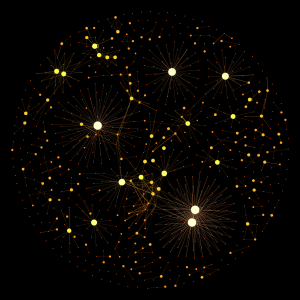
Some researchers look into possibilities to predict real “me” by analysing what and how was said on social media.

This network of galaxies is a new project to get insights on how and where childhood cancer is placed on social media. It is a collaborative project with Prof Richard Arnett. It is already very exciting and more to come!


What is the risk group classification system?

To be able to guide the treatment of neuroblastoma patients, doctors have developed a number of classification systems. Although sharing common features, they slightly vary by medical center, country and continents making direct comparisons of treatment results difficult. Doctors and scientists are trying to consolidate all systems in one in order to evaluate treatments in the past, currently ongoing and in the future.

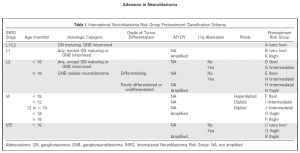
Scientists have suggested a newer risk group classification system, the International Neuroblastoma Risk Group (INRG) classification that would incorporate the best knowledge gained and recent advancements in the disease imaging and neuroblastoma molecular diagnostics. This system is based on imaging criteria using the image-defined risk factors (IDRFs) and the prognostic factors such as:

  • The child’s age
  • Tumour histology (the tumour appearance under the microscope)
  • The presence or absence of MYCN gene amplification
  • Certain changes in chromosome 11 (known as an 11q aberration)
  • DNA ploidy (the total number of chromosomes in the tumour cells)
The table is adapted from Pinto NR J Clin Oncol. 2015

Using these factors the INRG classification put children into 16 different pre-treatment groups (lettered A through R). Each of these pretreatment groups is within 1 of 4 overall risk groups:

  1. Very low risk (A, B, C)
  2. Low risk (D, E, F)
  3. Intermediate risk (G, H, I, J)
  4. High risk (K, N, O, P, Q, R)

This system has not yet become common across all medical centers, but it is being researched in new treatment protocols.

Doctors and scientists are planning to improve the INRG classification system by incorporating other molecular diagnostics data such as profiles of the neuroblastoma genome (DNA), transcriptome (RNA), and epigenome* in order to make precise prognostication even better.

* The epigenome is made up of chemical compounds and proteins that can attach to DNA and direct such actions as turning genes on or off, controlling the production of proteins in particular cells

References:

Pinto NR, Applebaum MA, Volchenboum SL, Matthay KK, London WB, Ambros PF, Nakagawara A, Berthold F, Schleiermacher G, Park JR, Valteau-Couanet D, Pearson AD, Cohn SL. Advances in Risk Classification and Treatment Strategies for Neuroblastoma.J Clin Oncol. 2015 Sep 20;33(27):3008-17.

What is neuroblastoma?

Neuroblastoma is a childhood cancer. The word neuroblastoma consists of two words neuro and blastoma.The term neuro refers to nerves, blastoma  –  to a cancer of immature cells.

It starts in some types of nerve cells during embryo development.transforming immature nerve cells into cancerous cells. This type of cancer occurs most often in infants and young children mostly under the age of 5 years old.

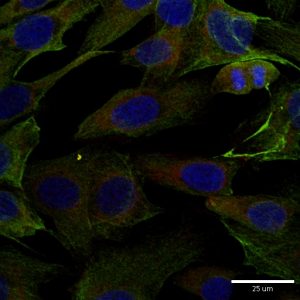
Neuroblastoma cells

Neuroblastomas behave very differently:


The types of treatment used for neuroblastoma can include:

Children who survive have a high chance of developing long term side effects as a result of the treatment that saved their lives

More details about neuroblastoma can be found here:

American Cancer Society

Cancer Research UK

What is cancer?

Cancer is an umbrella term that covers a group of diseases sharing the common features but diseases vary by site of origin, tissue type, race, sex, and age. One of the main features is an uncontrollable growth of cells. These cells are capable of spreading to other parts of the body. This process is also known as invasion and metastasis.

Though cancer in kids is not the same as in adults, childhood cancer cells behave in the same way. They grow uncontrollably and can travel to new destinations in the body.

This video ‘Cancer: from a healthy cell to a cancer cell’ nicely explains this transformation.

This video ‘How does cancer spread through the body?’ gives a perspective on the ways cancer cells travel in the body.

September is Childhood Cancer Awareness Month

September is Childhood Cancer Awareness Month!
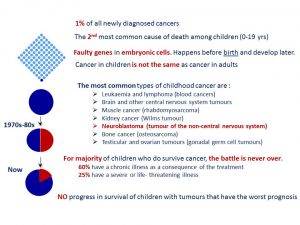
Facts about childhood cancer

Please watch this video created by St. Baldrick’s Foundation | The Childhood Cancer Ripple Effect

References:
Gatta G, Botta L, Rossi S, Aareleid T, Bielska-Lasota M, Clavel J, et al. Childhood cancer survival in Europe 1999-2007: Results of EUROCARE-5-a population-based study. Lancet Oncol. 2014;15(1):35–47.
Ward E, Desantis C, Robbins A, Kohler B, Jemal A. Childhood and Adolescent Cancer Statistics, 2014. Ca Cancer J Clin. 2014;64(2):83–103.
Dolgin MJ, Jay SM. Childhood cancer. 1989;327–40.
Miller RW, Young Jr. JL, Novakovic B. Childhood cancer. Cancer [Internet]. 1995;75(1 Suppl):395–405.
Raab CP, Gartner JC. Diagnosis of Childhood Cancer. Primary Care – Clinics in Office Practice. 2009. p. 671–84.
Howlader N, Noone A, Krapcho M, Garshell J, Miller D, Altekruse S, et al. SEER Cancer Statistics Review, 1975-2011 [Internet]. National Cancer Institute. 2014.
Ries L a. G, Smith M a., Gurney JG, Linet M, Tamra T, Young JL, et al. Cancer incidence and survival among children and adolescents: United States SEER Program 1975-1995. NIH Pub No 99-4649. 1999;179 pp
Warren KE. Diffuse intrinsic pontine glioma: poised for progress. Front Oncol [Internet]. 2012;2(December):205.
Lackner H, Benesch M, Schagerl S, Kerbl R, Schwinger W, Urban C. Prospective evaluation of late effects after childhood cancer therapy with a follow-up over 9 years. Eur J Pediatr. 2000;159(10):750–8.


SIOPEN Meeting 2017

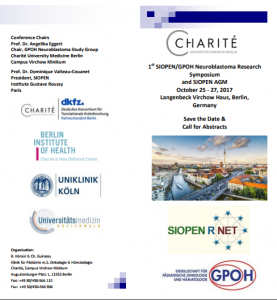
The dates for the SIOPEN AGM and Neuroblastoma Research Symposium were announced. This meeting will be hosted by the German So­cie­ty for Pa­ed­ia­tric On­co­lo­gy and Hae­ma­to­lo­gy and will take place @ Langenbeck Virchow Haus, Berlin, Germany on October 25-27, 2017.

Mission
To increase the understanding of neuroblastoma pathogenesis,
progression and treatment failure and to improve survival
and quality of life for children with neuroblastoma.

Main Objectives

  • To consolidate a platform for global collaboration
  • To establish networks of multidisciplinary caregivers
  • To develop new trial protocols
  • To develop standards for radiotherapy and surgery
  • To develop SOPs for biomaterial collection, handling and storage
  • To develop SOPs for application of major research technologies
  • To identify leaders for specific topics

Scientific Topics/Plenary Sessions

  1. Molecular Risk Stratification
  2. Liquid Biopsies
  3. Tumor Heterogeneity+Tumor Microenvironment
  4.  New Preclinical Models: PDX, GEMM, zebrafish
  5. New Immunotherapy Approaches
  6. New Drug Targets/Early Clinical Trials
  7. Neuroblastoma Pathogenesis/Genetics
  8. Targeting MYC
  9. Targeting ALK
  10. Targeting RAS/MAPK
  11. SIOPEN HR-NBL2 Clinical Trial Strategy
  12. Update ongoing SIOPEN trials: HR-NBL-1, LINES, VERITAS, OMS
  13. Update SIOPEN Bioportal
  14. Concept Biology+Relapse Umbrella Trial

August is a very quiet month

It is very quiet in the lab this month. No troubleshooting, no more long working hours, endless repetition of experiments, smiles and upsets… Almost all students completed their projects, submitted their works for grading and graduated. The last student is finishing at the end of August.

Time to focus on the collected data, reading literature, writing papers and new grants.

http://www.ifunny.com/pictures/its-rather-interesting-phenomenon-every-time-i/

Neuroblastoma Research Dream Team 2017

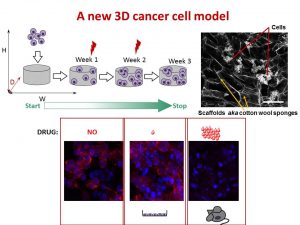
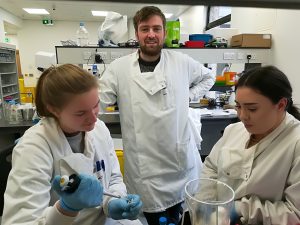
It is fantastic to see so knowledgeable and enthusiastic young researchers in my research group. This year, the team is multinational with the Irish students mixing with Belgian and Malaysian. All together they are cracking the code of neuroblastoma microenvironment and tumour cells communication through understanding main differences between conventional cancer cell models and tumours.

The big research plan of the entire team consists of more smaller and focused projects to be completed within 10-12 weeks. All projects are unrestricted, they are driven by the intellectual curiosity of these students. This way is full of ups and downs, frustrations and encouragements when techniques do not work or reagents do not come in as expected. Some cancer concepts can also work differently in the given settings. Simple questions are bringing more challenges than expected.  But at the end of the road is the best reward – contribution to the conceptual advancement of neuroblastoma microenvironment.


The Neuroblastoma Research Dream Team 2017: Dr. John Nolan, NCRC funded researcher, RCSI, Joe O’Brien, TCD MSc student, Ciara Gallagher, DIT undergraduate student, Jessica Tate, RCSI Medical student, Larissa Deneweth, Erasmus student, Ghent, Ying Jie Tan, TCD MSc student.