
In research, sophisticated technologies—single-cell sequencing, high-dimensional flow cytometry, or multi-omics analyses—often capture our attention. Yet the reliability of these approaches frequently depends on a much less celebrated step: the quality of the biological sample.
Recently, I revisited one of the most fundamental procedures in immunology research—peripheral blood mononuclear cell (PBMC) isolation. Although the technique is well established, performing it reminds me that careful sample preparation is not simply a technical prerequisite; it is an essential determinant of data quality and experimental reproducibility.
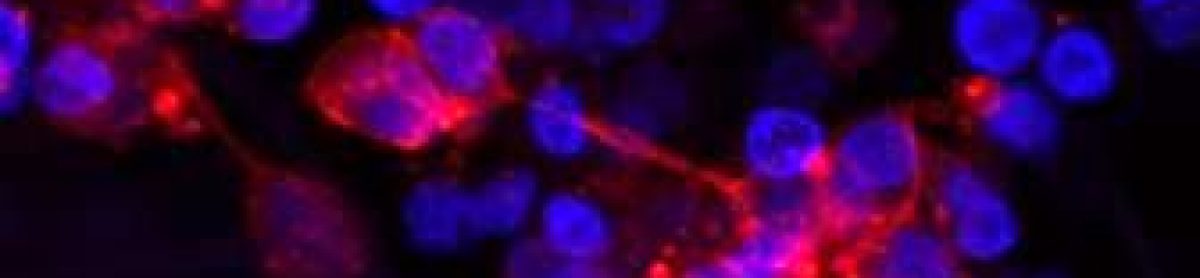
PBMCs, comprising lymphocytes and monocytes, are central to investigating immune responses in cancer, infectious diseases, and inflammatory disorders. Whether the downstream application involves functional assays, flow cytometry, transcriptomic profiling, or cell-based therapeutics, the integrity of the isolated cell population directly influences the biological conclusions that can be drawn (Figure 1).
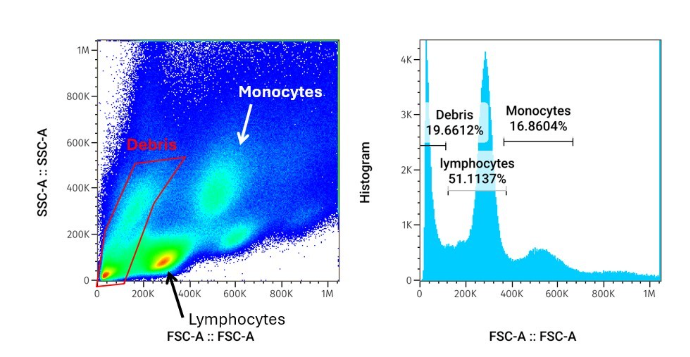
Forward scatter area (FSC-A) and side scatter area (SSC-A) were used to distinguish the major PBMC populations following density gradient isolation. Lymphocytes and monocytes were identified based on their characteristic size and internal complexity, while debris was excluded from downstream analyses (left). The corresponding FSC-A histogram illustrates the relative distribution of debris, lymphocytes, and monocytes within the isolated PBMC sample (right).
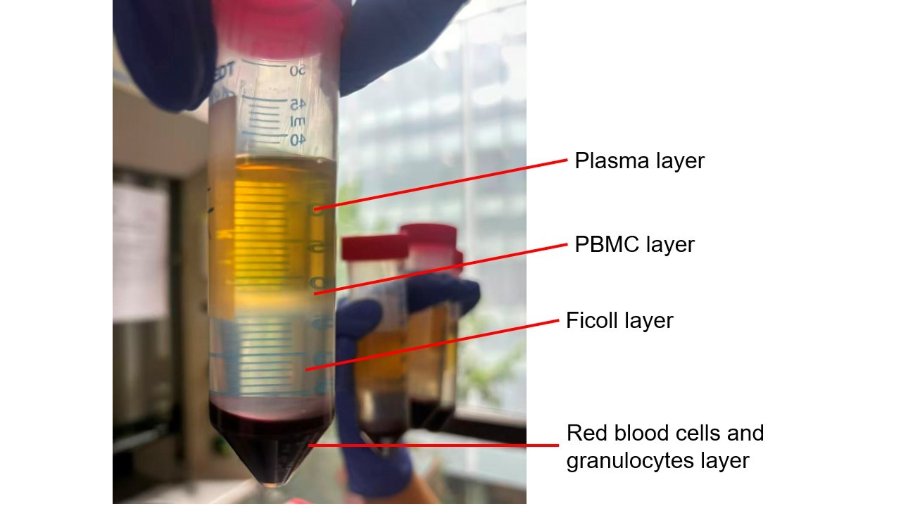
What continues to fascinate me is how much depends on meticulous execution. Maintaining a clean density gradient, preserving the delicate mononuclear cell layer during collection, and minimising contamination from granulocytes or erythrocytes all require patience and precision (Figure 2). These are not merely procedural details; they represent the difference between generating robust, reproducible data and introducing avoidable experimental variability.
As scientists, we often focus on interpreting complex datasets and uncovering novel biological mechanisms. However, every dataset begins long before the computational analysis. It begins at the bench—with careful pipetting, thoughtful experimental planning, and respect for the biological specimen.
PBMC isolation reminded me that scientific rigor is cumulative. Advanced technologies cannot compensate for poor sample quality, whereas meticulous preparation provides the foundation upon which meaningful discoveries are built. The most impactful science is not only driven by innovative ideas but also by consistency, attention to detail, and an appreciation that every step of an experiment contributes to the final result.
Sometimes, the quietest procedures in the laboratory are the ones that have the greatest influence on the science that follows.
Written by Lin Ma