Fundraising for Childhood Cancer Research

Dedicating posts to neuroblastoma and childhood cancer awareness month, it is impossible to stay distant about the need of fundraising to fund research. The #ChildhoodCancerAwareness Campaign aims not only attract our attention to the fact that kids get cancer too, but mostly to show how little is done to understand the causes of the disease and offer effective treatments.

  • To address the last problems more research is needed both curiosity-driven and translationally focused. To answer the question why research needs more funding, in general, you can find here.
  • Effective treatments cost money: only 4% of research funding goes to research in ALL childhood health conditions. In the other words, every 4 cents of each 1 euro are to be used in research.
  • The causes of childhood cancer including neuroblastoma are not known. It would be right to expect more blind alleys and failed ideas in the understanding these cancers.
  • The research can take decades, so it is a long-term investment. In contrary, people, who can give money (the politicians and governments), have 4-5 years of political power. 4-5 years vs decades = the discovery research becomes critically underfunded.
  • Who can change the situation? You, me and anyone. People who care. It happens through their active position and fundraising. Like the Foleys, Childhood Cancer Foundation and the Children’s Medical and Research Foundation.
  • Fundraising creates opportunities for blue sky research and developing cancer treatments.
If plants can grow through stones, so we can make a change.


Thank you all who support cancer research charities!


http://neuroblastomablog.com/why-do-we-need-fundraising-for-cancer-research/

Childhood and Cancer

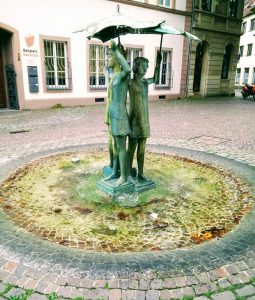
Walking in Mainz last week I saw a lovely fountain capturing 3 girls under umbrellas (Drei-Mädchen-Brunnen) at the ball square. This fountain was built between two Catholic girl’s schools symbolising the separate education and happy childhood. It has charmed me and reminded rainy days in Ireland and how this fountain may fit any park or square in Dublin.

My second look at the picture gave me another perspective. This sculpture could illustrate not only happy childhood but also the protection we can give to children with cancer being their umbrellas. As September is childhood cancer awareness month, I am picking this picture to support this call. Raising awareness about childhood cancer we help to make their dreams come true. Dreams for better treatment, better quality of life full of love ahead through better funding of childhood cancer research and access to innovative treatments.

Three girls fountain in Mainz Germany

September is Childhood Cancer Awareness Month

September is Childhood Cancer Awareness Month!
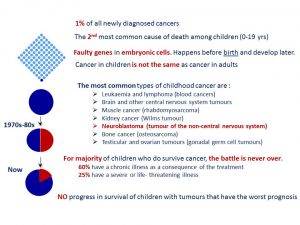
Facts about childhood cancer

Please watch this video created by St. Baldrick’s Foundation | The Childhood Cancer Ripple Effect

References:
Gatta G, Botta L, Rossi S, Aareleid T, Bielska-Lasota M, Clavel J, et al. Childhood cancer survival in Europe 1999-2007: Results of EUROCARE-5-a population-based study. Lancet Oncol. 2014;15(1):35–47.
Ward E, Desantis C, Robbins A, Kohler B, Jemal A. Childhood and Adolescent Cancer Statistics, 2014. Ca Cancer J Clin. 2014;64(2):83–103.
Dolgin MJ, Jay SM. Childhood cancer. 1989;327–40.
Miller RW, Young Jr. JL, Novakovic B. Childhood cancer. Cancer [Internet]. 1995;75(1 Suppl):395–405.
Raab CP, Gartner JC. Diagnosis of Childhood Cancer. Primary Care – Clinics in Office Practice. 2009. p. 671–84.
Howlader N, Noone A, Krapcho M, Garshell J, Miller D, Altekruse S, et al. SEER Cancer Statistics Review, 1975-2011 [Internet]. National Cancer Institute. 2014.
Ries L a. G, Smith M a., Gurney JG, Linet M, Tamra T, Young JL, et al. Cancer incidence and survival among children and adolescents: United States SEER Program 1975-1995. NIH Pub No 99-4649. 1999;179 pp
Warren KE. Diffuse intrinsic pontine glioma: poised for progress. Front Oncol [Internet]. 2012;2(December):205.
Lackner H, Benesch M, Schagerl S, Kerbl R, Schwinger W, Urban C. Prospective evaluation of late effects after childhood cancer therapy with a follow-up over 9 years. Eur J Pediatr. 2000;159(10):750–8.