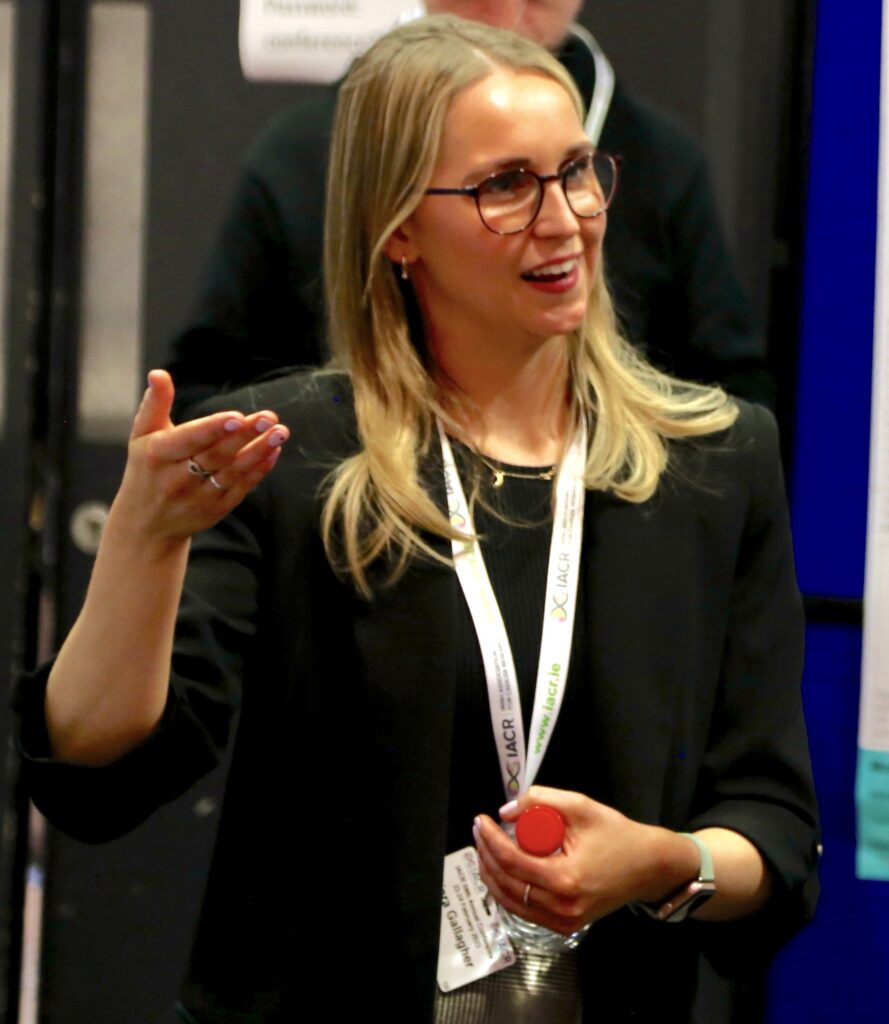
Huge congrats to a newly minted Dr Ciara Gallagher! She defended her PhD on March 8 – International Women’s Day. Your enthusiasm and perseverance are truly fascinating! May this be the stepping stone towards a brighter future, Ciara!
We thank examiners Dr Marie McIlroy (RCSI) and Prof Jan Škoda (Masaryk Uni) for the time and expertise they provided.
We also thank the Irish Research Council for their generous support!
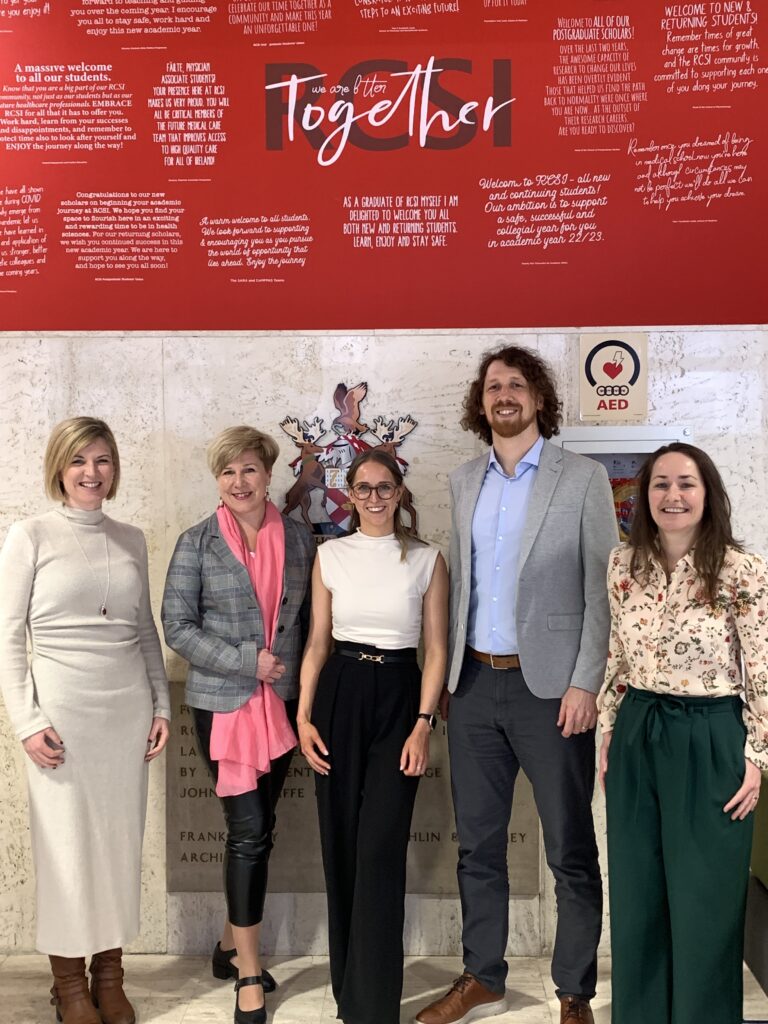
Dr Ciara Murphy (Chair), Dr Olga Piskareva (Supervisor), Dr Ciara Gallagher, Prof Jan Skoda (examiner), Dr Marie McIlroy (Examiner)
Researchers use various methods, but I employ gene knockdown in my experiments. Basically, I use small RNA molecules that specifically target and degrade the mRNA of my gene of interest. This leads to a decrease in the corresponding protein levels, enabling me to observe the effects on neuroblastoma cell behaviour.
I feel a bit like Sherlock Holmes, you know? I’m selectively putting my suspect protein – the one I’m eyeing – under the spotlight to see how it’s pulling the strings on the cell’s behaviour. It’s like I’m in a cellular mystery, complete with a gene knockout magnifying glass 🔍🧬🕵
So, what I’ve been up to these past months is knocking down my protein and trying to find answers to the following questions:
Can neuroblastoma cells survive? And if not, how do they meet their demise? Do they go on a growth spree and start proliferating? Are they capable of migration? And here’s the twist – when my protein of interest takes a dip, do other proteins decide to change their expression levels?
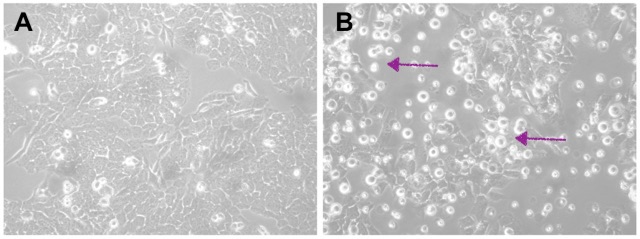
The picture below can probably help you get an idea of what I’ve done so far. Do you see those brighter spots in Pictures A and B? Those are dead cells. Their number indicates the proportion of dead cells after a treatment. Picture A has just a few; the majority are healthy and well-spread cells. This is our negative control, a condition when we show neuroblastoma cells that have been transfected, but no gene knockdown happened. Transfection is the term for introducing small RNA molecules. Now, in Picture B, when we knocked down the protein, it caused the death of the cells, and you can clearly see that from all those many little bright spots.
We have found answers to many of the previous questions, but new questions have arisen, and we can’t wait to answer them!
For our next little series introducing a different thing in science and how it works every week, I decided to focus on classifiers. With artificial intelligence becoming more and more prominent in our daily lives as of late, I thought this would be a good lead into the explicitly science-focused topics to come. So, what is a classifier? How does it work? And why does it matter?
At their core, classifiers are algorithms designed to categorize input data into predefined classes or categories. They learn patterns and relationships from labelled training data to make predictions on new, unseen data.
Once features are extracted, identified and quantified from labelled or annotated input data, mathematical models are employed for pattern recognition and predictions.
These models can range from simple decision trees to complex neural networks, each with its own strengths and weaknesses.
Training these models is an iterative process. That means to produce one good classifier, lots of classifiers were created in the process: Every time the pattern recognition is run, the annotated data is categorised by the classifier and compared to the annotation class. Prediction errors are corrected, and performance is optimised. This whole process is one iteration. How many iterations are required for a well-trained classifier varies widely and is largely dependent on the input data and application. For my tissue classifiers, it took up to 20,000 iterations.
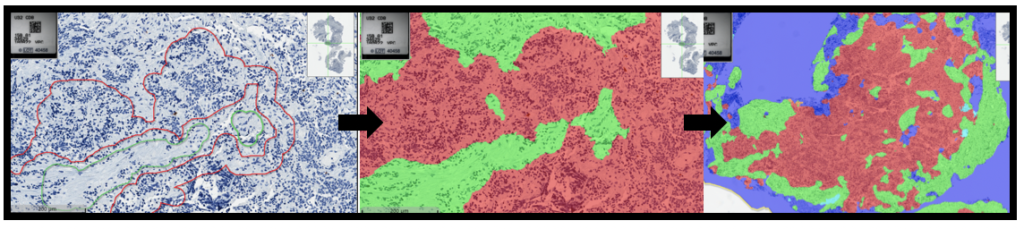
Classifiers use these models to categorise unseen data into categories the user-defined at the start. In the figure, you can see my annotated histological slides from which the classifier extracted patterns to then classify the rest of the slide and entirely unseen slides into tumour (red), stroma (green) and background (blue) classes.
From identifying fraudulent transactions, filtering out junk mail, targeted advertising, and facial recognition to unlock your phone or diagnosing diseases, classifiers play a vital role in automating decision-making processes and driving advancements across a wide range of industries. Keep your eyes peeled, and you can find more classifiers in action all around you.
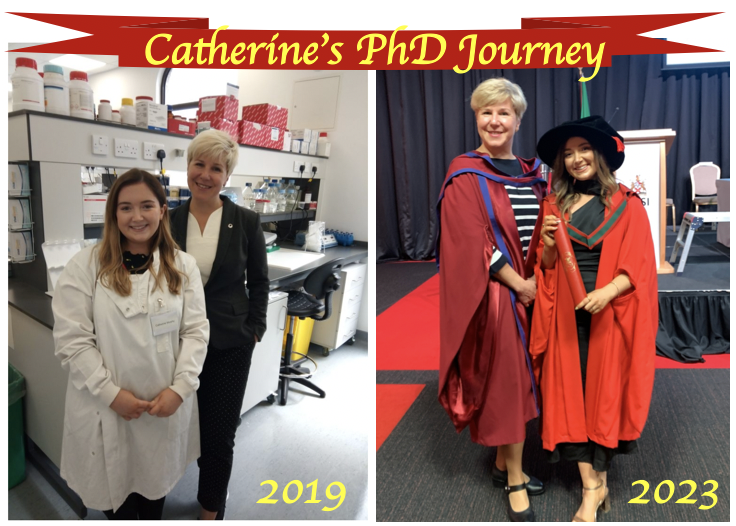
November 22, 2023 – Catherine was officially coined Dr Catherine Murphy. A Big Day for Catherine, her family and me.
Catherine joined our team in July 2019 to carry out a research project funded by Neuroblastoma UK. In this project, she aimed to use 3D culturing to engineer a novel experimental model and study the biology and immunology of neuroblastoma, an aggressive childhood cancer. There was the full spectrum of challenges and hard work spiced up with the uncertainty of the COVID-19 restrictions!
The PhD journey is never a straight line. It has a range of colours with 50+ shades for each. There are black alleys and hidden cul de sacs. Between July 2019 and June 2023, some days were sunny and bright, and some had scattered showers, gale winds and stormy snow, with sunshine developing elsewhere. The journey was spiced up with publications, conferences, travels, days out and fundraising events with the team.
Of note, she was behind our Twitter activities and blogging #AskCat, making our team visible! All these together have moulded into a new multi-skilled professional – Dr Catherine Murphy!
Well done to Catherine! Wish you the best of luck in your new adventure!
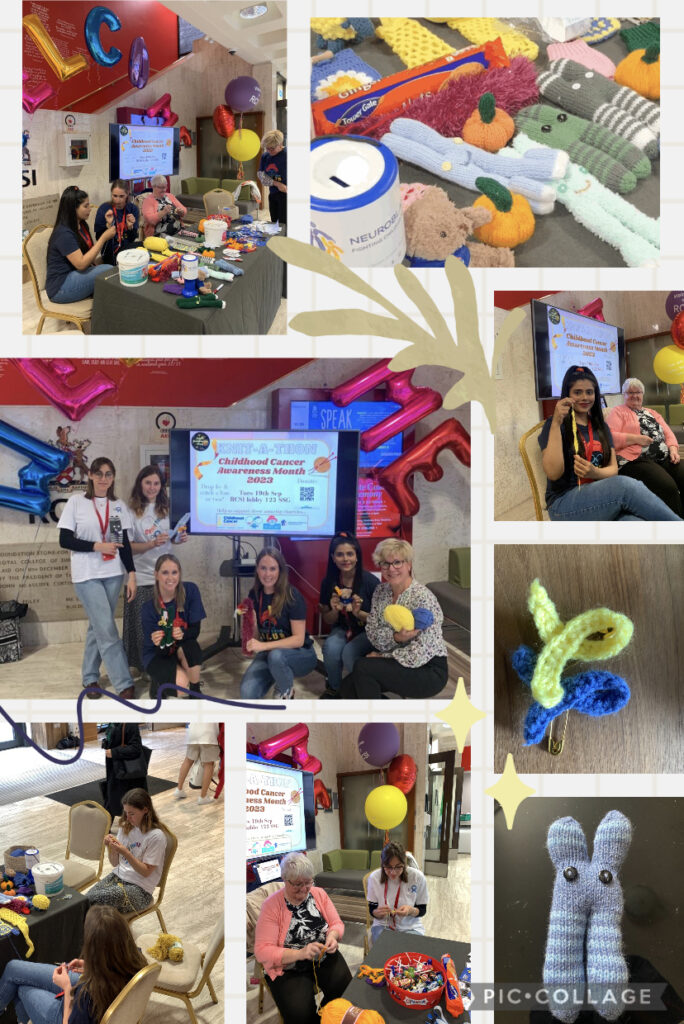
A wonderful day of knitting – Knit-A-Thon-2023 raised 913 euros. A massive thank you to everyone who stopped by and donated on the day and beyond. Every cent counts! The money was split evenly between our four chosen charities: The Conor Foley Neuroblastoma Research Foundation (CFNRF), Neuroblastoma UK (NBUK), Oscars Kids and Childhood Cancer Ireland (CCI). These charities were established and are run by parents, some of whom lost their children to cancer. They continue their children’s legacy, doing an amazing job of advocating for children with cancer and better funding for research and aftercare.
Knit-A-Thon 2023
And a special thank you to Ciara’s mam Aggie for the amazing handmade raffle prizes (chromosomes, antibodies, cup holders and many more) and a Master class on the day! We thank Jenny Duffy (RCSI Events and Communications Coordinator) for her time crocheting with us and for us! Thanks to Anggie’s and Jenny’s skills, there were lots of mascots to win – and many of them collected already. We much appreciate the support from the RCSI Estates and Porters who looked after us on the day.
We are the Cancer Bioengineering Group, and September is a very special month for us as it is Childhood Cancer Awareness Month. Childhood cancer is the 2nd leading cause of death in children after accidents. Our group researches childhood cancer neuroblastoma, a cancer of immature nerve cells. Despite intensive multimodal treatment, as many as 1 in 5 children with aggressive neuroblastoma do not respond, and up to 50% of children that do respond experience disease recurrence with many metastatic tumours resistant to many drugs and more aggressive tumour behaviour that all too frequently results in death.
This is what we want to change! We believe that every child deserves a future, and our team of postgraduate researchers led by Dr Olga Piskareva is dedicated to strengthening our knowledge of this disease and identifying new potential ways to tackle it, as well as taking part in fundraising activities so our group and others can continue with this research.
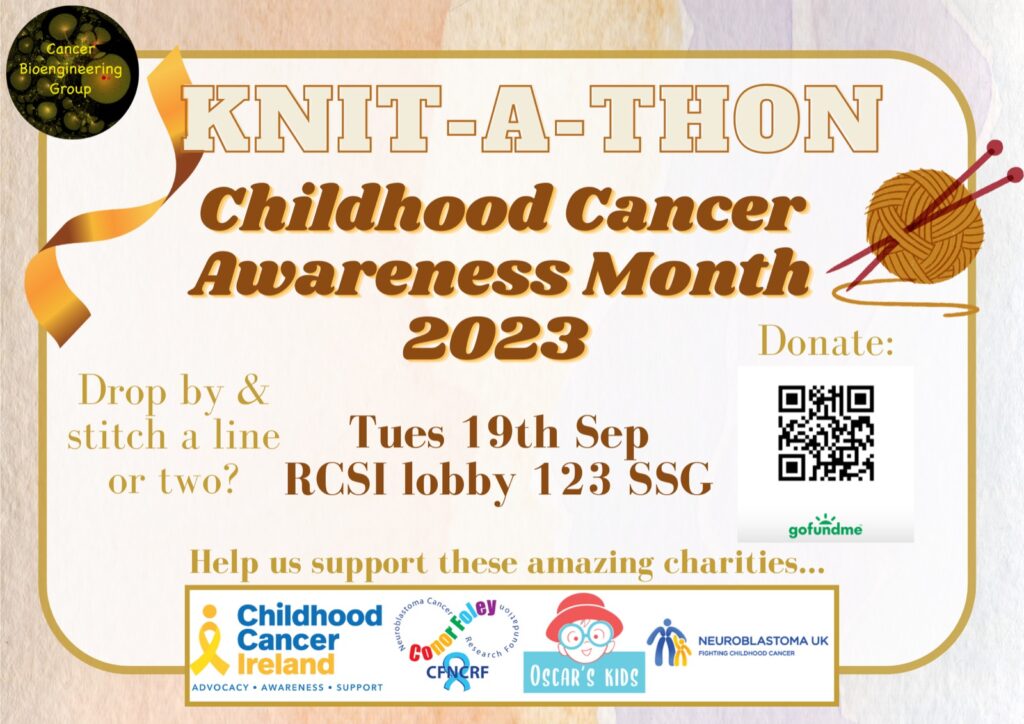
On Tuesday, the 19th of September, we are running a Knit-A-Thon using gold and purple yarn to mark childhood cancer and neuroblastoma, respectively. Our patterns are inspired by Neuroblastoma UK and Mr Google, indeed.
This year, we honour 4 charities that are doing an amazing job of advocating for children with cancer and better funding for research and aftercare. Therefore, the donations we receive will be split equally among The Conor Foley Neuroblastoma Research Foundation (CFNRF), Neuroblastoma UK (NBUK), Oscars Kids and Childhood Cancer Ireland (CCI). If you would like to get involved in the Knit-A-Thon and help us raise vital funds for childhood cancers, come along on the day and make a donation to these wonderful charities.
On the day, RCSI 123 SSG will #GoGold in support of this cause. Please come by to see the RCSI building lit up and share your pictures on social media with the hashtag #ChildhoodCancerAwarenessMonth to raise awareness.
Ready, Steady, Go!
Every year we manage to raise an amazing 1500-2000 euros by organising a new challenge. We are eager to surpass that target this year. All donations no matter how small are appreciated at GoFundMe.
Hi there, Ciara here again, a final-year PhD student in our research group. I can’t believe September has rolled around again, meaning one thing: it’s Childhood Cancer Awareness Month (CCAM). In honour of this month, I would like to tell you a little bit about the childhood cancer we study in our lab and the research that I do to one day help save children from this disease.
Neuroblastoma is an aggressive childhood cancer, with sadly only 20% of late-stage patients surviving after 5 years. Progressive disease and cancer relapse are common in neuroblastoma. This is due to standard treatment regimens not being adequate for treating high-risk patients. Current treatment also may cause a series of adverse reactions in patients. Therefore, my research focuses on developing a 3D model of high-risk neuroblastoma that models the cancer more accurately in a laboratory setting. This will act as a beneficial platform to test whether new therapies effectively fight the patients’ cancer cells, leading to better treatment options for children with neuroblastoma.
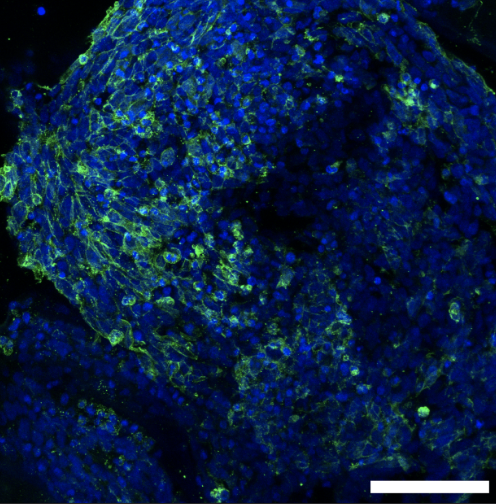
Below is a picture of how we grow these cancerous cells on our 3D model and visualise them with fluorescent stains. When we can see them like this under a microscope, we can study how they move and grow to help us understand how to treat them.
Here, we can see the cells growing on our 3D cancer model. This image is magnified by 200 times to be able to see the individual cancer cells. The green stain is the outside of our cancer cells, or we use the term, the cell membrane. The blue is the inside, or as some of you may know the term, the nucleus of the cell. (It is amazing what we can see with the power of microscopes, right?)
As you may know, every year, we support amazing charities by raising vital funds to keep the fight against childhood cancer going. Keep your eyes peeled on our Twitter for updates on what crazy activity we have committed to this year!!
Every September, we celebrate Childhood Cancer Awareness Month. This is a great opportunity to raise awareness about childhood cancer. Unfortunately, kids get cancer, too. While much research has been done to understand how cancer develops in adults, we still know very little about what exactly leads to cancer in children.
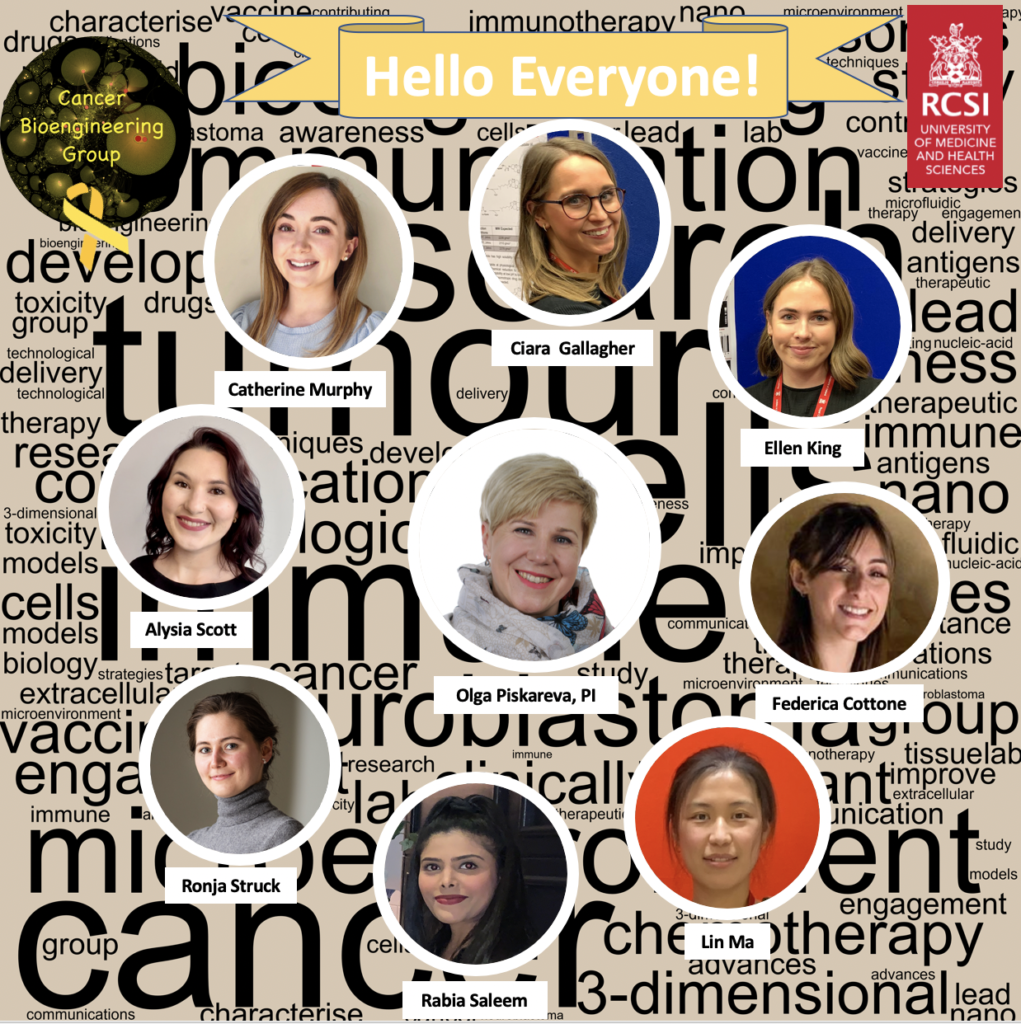
We are the Cancer BioEngineering Group led by Dr Olga Piskareva at the RCSI University of Medicine and Health Sciences. Our research focuses on neuroblastoma, an aggressive childhood cancer of immature nerves. The group has 7 PhD students developing research projects around neuroblastoma biology. One postgraduate student successfully defended her work and was awarded a PhD last month.
We are a dynamic group proud to be engaged in research, science communication and patient involvement. We do that through different initiatives. Throughout September, we will share many of them and invite you to keep following us on social media.
Team 2023
Our projects address topics related to neuroblastoma microenvironment, cell interactions, tumour resistance and the development of new therapies. To do that, we use 3D in vitro models, identify immunotherapeutic targets and evaluate extracellular vesicles.
We are always happy to answer questions and interact with the public. Follow us on our social media channels and read our blog to learn more about us and our research.
We are running a fundraising event, “A knit-a-thon,” on the 19th of September. Stay tuned!
Thanks for reading, and we go ahead with neuroblastoma research!
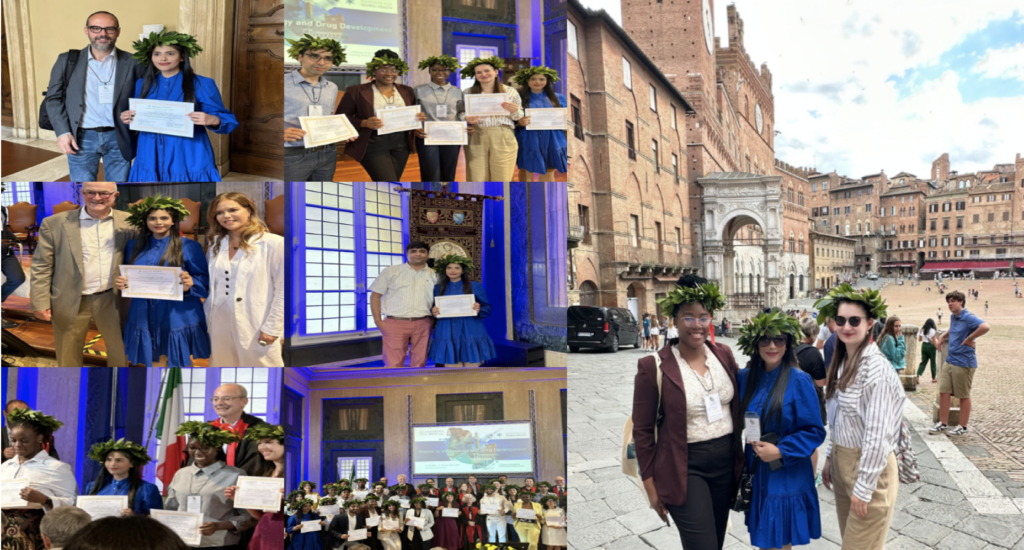
This blog takes you to the exciting scene of my MSc graduation ceremony at the University of Siena, Italy, completed with the prestigious laurel wreath.
I graduated during COVID-19, but there was no graduation ceremony at that time. Years later, I was invited to attend an “Alumni conference” by the University of Siena, but the plan was still unclear. When we arrived in Siena, we came across that there was a convocation ceremony tomorrow. Hold on! What? Yes, after years of waiting, it was finally taking place on June 7, 2023.
The next morning, all the former students from 48 countries came together in the University’s Grand Piazza del Duomo, where all of the Professors and sponsors, robed in their academic attire, delivered speeches that inspired and reminded us of the responsibility that comes with education, which ended in the most captivating moment of adorning us with laurel wreaths stating that “Rating your thesis attributes by authority granted to me by director I confer you the Masters Diploma in Vaccinology and Drug Development, Congratulations!”. The weight of this academic success was alleviated by our family members’ joyful yells and applause.
Walking out of the ceremony, wreathed in laurel, walking through Siena’s streets with classmates I’ve never met in person, hearing these words “Complimenti! Felicitazioni!” from commoners, I came back to Dublin with an ethereal sensation of pride and belonging that will remain with me for life. Altogether, It was a once-in-a-lifetime experience for me.
Here are some glimpses of the ceremony:
P.S.: But this was not the end. I embarked on a wet-lab MSc in RCSI Dublin. As I am typing these lines, my MSc by Research work has just been submitted for examination, marking another hallmark and opening a new chapter in my life, “the PhD journey”.The new chapter – the new challenges and opportunities!