Having recently started my PhD, I wanted to use this journal club as an opportunity to develop a deeper understanding of the scientific background underpinning my proposed research. In particular, I was interested in exploring how previous publications from our laboratory relate to my project and how existing research can help inform the experimental approaches I will be using over the coming years.
For this journal club, I selected a review by King, Struck and Piskareva (2025), published in Translational Oncology, which discusses the current challenges in neuroblastoma immunotherapy, with particular emphasis on the importance of three-dimensional (3D) tumour models in investigating tumour–immune interactions.
Traditional two-dimensional (2D) cell cultures are widely used in cancer research but cannot fully reproduce the structural and biological complexity of solid tumours. In contrast, 3D models provide a more physiologically relevant environment by incorporating cell–cell interactions, extracellular matrix (ECM) components, spatial organisation and diffusion gradients. These factors can significantly influence tumour behaviour, immune-cell infiltration and responses to immunotherapeutic treatments.
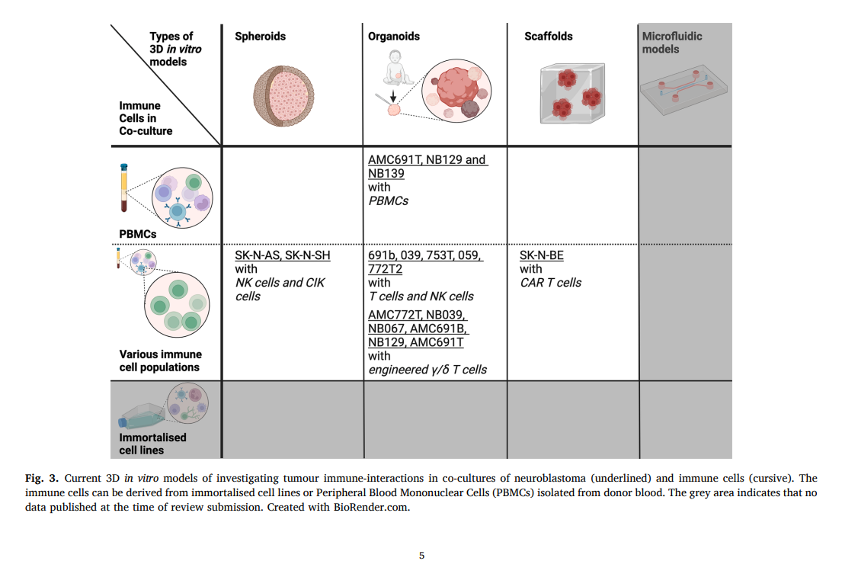
Figure 3 of the review was particularly interesting, as it provides an overview of published 3D neuroblastoma models, including spheroids, organoids and scaffold-based systems, and their incorporation with different immune-cell populations such as natural killer (NK) cells, T cells and chimeric antigen receptor (CAR)-T cells. The figure highlights the range of experimental approaches already established for investigating tumour–immune interactions, while also identifying combinations for which published evidence was unavailable at the time of the review.
Using synthetic PeptiMatrix-based 3D hydrogel models, my project aims to investigate whether GPC2 contributes to changes in tumour-derived ECM composition, matrix mechanical properties and the accessibility of therapeutic immune cells. By examining different structural variants of GPC2, the research will explore how its molecular features may influence matrix organisation and, ultimately, immune-cell penetration and tumour-cell killing.
Exploring this review has helped me better appreciate the rationale behind using 3D models in my own research and understand how my proposed experiments build upon established approaches within the laboratory. It has also highlighted the importance of investigating not only how immune cells recognise tumour antigens, but also how the surrounding tumour microenvironment may influence their therapeutic effectiveness.
As I begin my PhD journey, connecting published research with my proposed experimental work is an important first step towards understanding the broader scientific questions my project aims to address.
Written by Alannah O’Neill, POI-2 PhD Student